Rugby League World Cup | History And Winners
The Rugby League World Cup is one of the oldest World Cups in world sport, first played in France in 1954.
Since then, it has survived cancellations, format changes and long gaps, and made a comeback every time.
So how did it all begin, and how did it become the tournament fans know today?
The Rugby League World Cup began in 1954 as the idea of French rugby league president Paul Barrière, and it has since grown into three tournaments for men, women and wheelchair players.
Only three nations have ever won the men’s title: Australia, Great Britain and New Zealand.
In this guide, we walk through the complete history of the tournament, from 1954 to the upcoming RLWC 2026.
If you just want the champions, our Rugby League World Cup winners list by year has every result.
Rugby League World Cup
The Rugby League World Cup is the premier international competition in rugby league football.
The Rugby League World Cup is organised by the sport’s global governing body, International Rugby League (IRL).
The IRL brings together the best national teams from across the world to compete for the Paul Barrière Trophy.
The trophy of the Rugby League World Cup is named after the French Rugby League President, who was the driving force behind the tournament.
At the time, the RLWC shows three different competitions simultaneously, which are the Men’s World Cup, the Women’s Rugby League World Cup, and the Wheelchair Rugby League World Cup.
All three carry equal prominence under the RLWC banner, making it one of the most inclusive major sporting events in the world.
You May Also Like: How To Watch Rugby League World Cup 2026
Rugby League World Cup History

Like every other sport or any other tournament, the Rugby League World Cup has a very long history.
We are going to divide this long history in 3 parts so that users can understand more easily and enjoy better.
1) The Beginning Of The Rugby League World Cup
The idea of the Rugby League World Cup basically came from France in the 1930s.
The main force behind the Rugby League World Cup was the French Rugby League, which had grown quickly in France in the 1930s and 40s.
Paul Barrière, President of the French Rugby League, raised the idea formally in 1951, and after gaining backing from the Rugby Football League in England.
The International Board officially agreed to hold the first tournament in 1953, with France as the host nation.
In 1954, the very first Rugby League World Cup took place in cities across France, including Paris, Lyon, and Bordeaux.
At that time, It featured just four teams: Great Britain, France, Australia, and New Zealand.
Great Britain won that tournament, defeating France 16–12 in the final in Paris on 13 November 1954.
2) The Decentralized Era: 1985–1992
From 1985 to 1992, the World Cup tried something completely different.
Instead of a single host nation and a few weeks of matches, the tournament spread across multiple years in a home-and-away format.
In this, the teams played each other twice, once at home and once away, with results also counting toward international tour standings.
It was not great, but it worked. Papua New Guinea made its World Cup debut during this era, bringing the competition to five nations for the first time.
Australia dominated both editions without question. The 1988 final at Eden Park in Auckland drew 47,363 fans, which is a New Zealand rugby league attendance record at the time.
As the Kangaroos beat the Kiwis 25–12. Australian captain Wally Lewis, in what became one of rugby league’s most iconic moments.
Four years later, the 1992 final moved to Wembley Stadium in London, where 73,361 people packed in to watch Australia defeat Great Britain 10–6.
It was a record crowd for any international rugby league match, and it stood for over twenty years.
It was also the last time Great Britain ever took the field as a unified team in the Rugby League World Cup.
3) The Modern Era
The 2013 World Cup in England set a new attendance record with 74,468 fans at the Old Trafford final, which surpassed the Wembley record from 1992.
Australia won it again, beating New Zealand 34–2.
The 2017 tournament, co-hosted by Australia, New Zealand and Papua New Guinea, produced another Australian win.
It was a tight one, too: Australia beat England 6–0 in the final.
The 2021 Rugby League World Cup, which was held in England but played in 2022 after a COVID-19 postponement, was arguably the greatest edition of the tournament ever staged.
Samoa, led by a squad full of NRL stars, reached the final against Australia after a famous semi-final win over England.
Australia eventually won 30–10, claiming their twelfth title, but it was also one of the best tournaments for Samoa.
Rugby League World Cup Winners
Only three nations have ever won the men’s Rugby League World Cup: Australia (12 titles), Great Britain (3) and New Zealand (1).
For every winner by year, with runners-up, final scores and hosts, see our full Rugby League World Cup winners list.
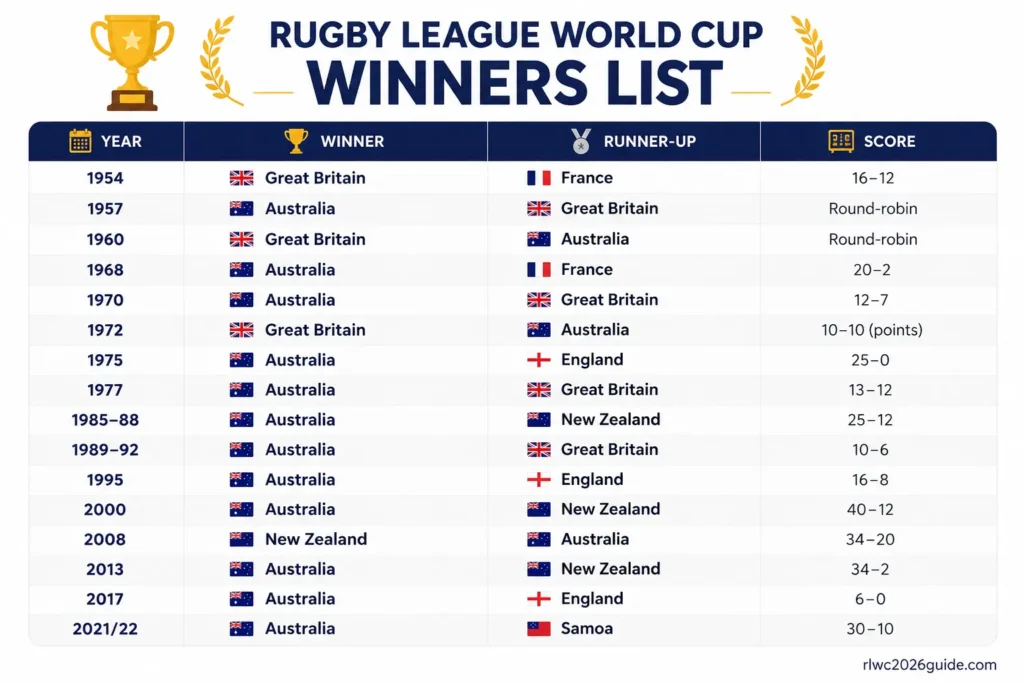
Winning 12 out of 16 tournaments is good enough to tell the dominance of the Australian Rugby team.
How Often Is the Rugby League World Cup Held?
The Rugby League World Cup is now held every four years. International Rugby League confirmed this four-year cycle in 2023.
It hasn’t always been that regular, though. In the early years, the gap between tournaments ranged from two to eight years.
There were World Cups in 1954, 1957, 1960, 1968, 1970, 1972, 1975 and 1977.
Then came the long home-and-away editions of 1985–88 and 1989–92, followed by 1995, 2000, 2008, 2013, 2017 and 2021.
The 2021 tournament was pushed back to 2022 because of COVID-19. Four years on, the cycle continues with RLWC 2026.
When Is the Next Rugby League World Cup?
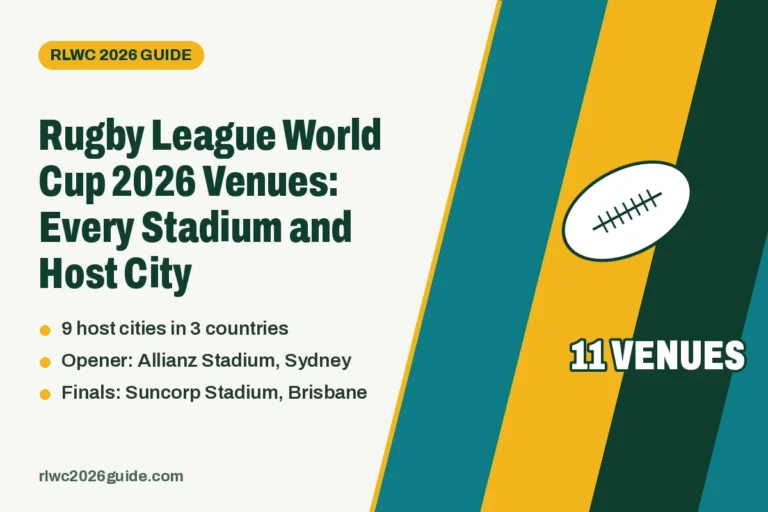
The next Rugby League World Cup runs from 15 October to 15 November 2026, across Australia, New Zealand and Papua New Guinea.
The Men’s, Women’s and Wheelchair World Cups are all played together, with the Men’s and Women’s Finals at Suncorp Stadium in Brisbane.
After 2026, the next men’s World Cup is due in 2030. In December 2025, the IRL confirmed that all three tournaments will keep being played together.
The 2030 host hasn’t been officially confirmed yet. Reports in late 2025 named the United States as the preferred choice.
Planning to follow this one? Our RLWC 2026 schedule lists every fixture, date and venue.
Rugby League World Cup 2026
The next Rugby League World Cup is coming, and it is shaping up to be the most ambitious edition so far.
The 2026 tournament will be hosted across Australia, New Zealand, and Papua New Guinea.
Rugby League World Cup 2026 is set to start on 15 October 2026, and the Grand Final is scheduled for 15 November 2026 at Suncorp Stadium in Brisbane.
Unlike the 2021 edition, which featured 16 teams in the Men’s competition, the 2026 Men’s World Cup has been reduced to 10 teams.
The ten confirmed men’s teams for RLWC 2026 are: Australia, New Zealand, England, Samoa, Tonga, Papua New Guinea, France, Lebanon, Cook Islands, and Fiji.
The Women’s and Wheelchair tournaments will each feature eight teams and run simultaneously alongside the Men’s competition.
Want to see the next chapter of this history in person? Adult tickets start at just $19 AUD. Our guide to Rugby League World Cup 2026 tickets covers prices, venues and the safest places to buy, and the RLWC 2026 schedule lists every fixture.
Conclusion
The Rugby League World Cup is among the biggest tournaments in sports and is loved by the fans.
It has grown from four teams in France in 1954 into three World Cups, with Australia’s long era of dominance along the way.
New Zealand’s historic 2008 win and Samoa’s unforgettable run to the 2021 final have added new chapters to the story.
The winners’ list tells one story clearly: Australia is the undisputed king of this competition.
The next chapter starts on 15 October 2026, across Australia, New Zealand and Papua New Guinea.
See every past champion in our winners list, and plan your viewing with our kick-off times guide.