Rugby League Eligibility Rules: Who Can Play for Which Country?
Why can a player who once played for Australia turn out for the Cook Islands or New Zealand at the Rugby League World Cup 2026?
It all comes down to the international eligibility rules, which decide who can play for which country.
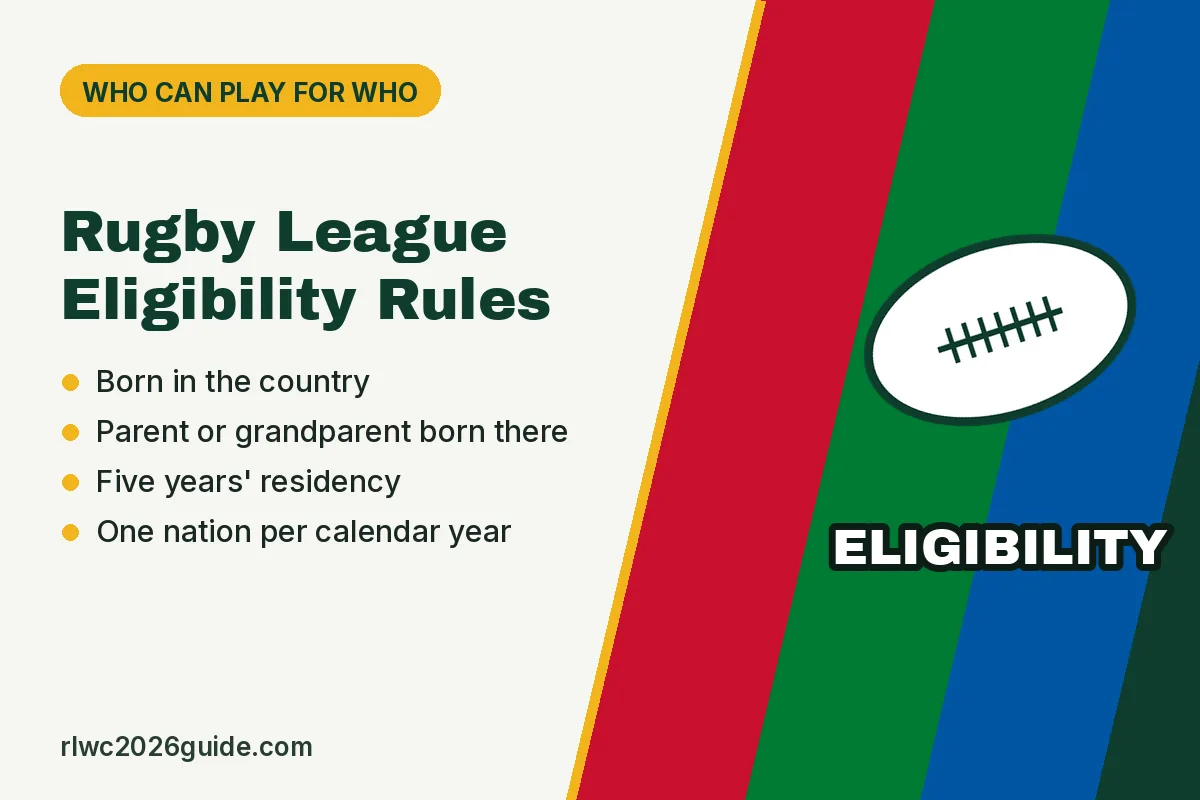
A rugby league player can represent a country if they were born there, if a parent or grandparent was born there, or if they have lived there for five years in a row.
Players can only play for one nation in a calendar year, and switching between Australia, New Zealand and England is mostly blocked.
That’s why stars like Valentine Holmes, Dane Gagai and AJ Brimson are wearing different jerseys at this World Cup.
Below, we explain the rules in plain English, how heritage and switching work, and which 2026 players have changed nations.
Quick Answer: Rugby League Eligibility Rules
- Birth: Born in the country
- Heritage: A parent or grandparent born there
- Residency: Five years living there
- One nation a year: No playing for two countries in a calendar year
- Big three: Switching between Australia, NZ and England is mostly blocked
- Women: Tiers scrapped in March 2026
What Are the Rugby League Eligibility Rules?
International Rugby League sets the eligibility rules for every Test and World Cup match.
A player qualifies for a country through birth, a parent or grandparent born there, or 60 months of residency. The residency period was raised from three years to five in 2016.
Since 2020, a player can only represent one nation in a calendar year, and only one nation at an IRL tournament like the World Cup.
A player also ‘elects’ a nation once they are named in a 19-man squad for a senior Test, not just when they take the field.
How Do Players Qualify Through Heritage?
Heritage is the most common route for Pacific nations. A player qualifies if any parent or grandparent was born in that country.
That’s why so many Australian and New Zealand-born NRL players can choose Tonga, Samoa, Fiji, Lebanon or the Cook Islands.
A great-grandparent doesn’t count. In 2006, New Zealand lost points from a Tri-Nations win after Nathan Fien played through his great-grandmother.
Today, IRL checks a player’s eligibility before he is selected, so cases like that are far less likely.
Can a Player Switch Countries in Rugby League?
Yes, but with limits. Australia, New Zealand and England are Tier 1 nations, and every other full member is Tier 2.
A player can choose one Tier 1 nation and one Tier 2 nation. He can change his Tier 2 nation only once every four years.
Switching between Australia, New Zealand and England is usually blocked, unless IRL’s appeals committee finds special circumstances.
The tier system opened the door in 2017, when Jason Taumalolo and other stars chose Tonga over New Zealand and Australia.
Which Rugby League World Cup 2026 Players Switched Nations?
These players have represented a different nation before the Rugby League World Cup 2026.
| Player | Played for | 2026 nation |
|---|---|---|
| Valentine Holmes | Australia | Cook Islands |
| Dane Gagai | Australia | New Zealand |
| AJ Brimson | Australia (World Cup 9s) | England |
| Kalyn Ponga | Australia (World Cup 9s) | New Zealand |
| Mitchell Moses | Lebanon | Australia |
| Luca Moretti | Italy | PNG |
Holmes played 21 Tests for Australia before joining the Cook Islands, a Tier 2 nation.
Gagai was cleared to switch to New Zealand through his mother, after an appeal on special circumstances. Ponga and Brimson could switch because the World Cup 9s didn’t count as a senior Test.
Moses captained Lebanon at the last World Cup, and he played for Australia this time. See the full Kiwis World Cup squad and England squad for more.
What Changed for Women and Wheelchair Players in 2026?
In March 2026, IRL scrapped the tier system for women, so women can now play for any of Australia, New Zealand or England that they qualify for.
Shannon Mato announced a switch from the Jillaroos to the Kiwi Ferns, and Paige Travis moved from England to Wales.
In May 2026, IRL also moved Australia and New Zealand to Tier 2 for the Wheelchair World Cup, to help those nations grow.
The one-nation-per-year rule still applies to everyone, men, women and wheelchair players alike.
Rugby League Eligibility Rules: FAQ
Here are quick answers to the questions fans ask most about eligibility.
Each answer starts with the key fact, so you can find it fast.
For the full rules, see the sections above.
Can you play for two countries in rugby league?
Yes, if you qualify for both.
You can only play for one in a calendar year.
Switching between Australia, NZ and England is mostly blocked.
How many years do you need to live in a country to play for it?
You need five years of residency.
That’s 60 months in a row.
It was three years before 2016.
Can New Zealand players play State of Origin?
Yes, since a change in February 2026.
They still need to meet the Origin rules.
Those include being born in NSW or Queensland.
Why did Jason Taumalolo switch to Tonga?
He chose Tonga in 2017 through his heritage.
The tier system made it possible.
He now captains Tonga.
Conclusion
Rugby league eligibility rules let players represent the country of their birth, their parents or grandparents, or their home of five years.
Players can only pick one nation a year, and switching between the big three is still tightly controlled.
Those rules shaped many teams at the Rugby League World Cup 2026. See who leads each side in our Rugby League World Cup 2026 captains guide.
Want our World Cup updates first? Add RLWC 2026 Guide as a preferred source on Google.